Delaware Hunts
Delaware is a small state located in the Mid-Atlantic region of the United States. Pennsylvania borders the State to the north, Maryland to the south and west, Delaware Bay, Delaware River, New Jersey, and the Atlantic Ocean to the east. Delaware’s terrain is mainly flat, with some rolling hills in the northern part of the State. The highest point in Delaware is only 1,043 feet above sea level. The State’s coastline features many Delaware Bay and Atlantic Ocean beaches.
The major rivers in Delaware are the Delaware River, which forms the border with Pennsylvania, and the Chesapeake Bay, which forms the border with Maryland. The influence of the Ocean moderates the States’ climate because most of it is on the Atlantic coastal plain. The State falls within the humid subtropical zone.
The State has three regions: the Atlantic coastal plain, the Piedmont plateau, and the Appalachian Mountains.
The Atlantic coastal plain is a narrow strip of land that runs along Delaware’s Atlantic coast. This region comprises sandy beaches, salt marshes, and pine forests. The Piedmont plateau is a region of rolling hills and fertile farmland. Finally, the Appalachian Mountains are a chain of mountains that run along the State’s western border.
Delaware’s diverse terrain and climate make it home to various plants and animals. The State has more than 500 species of plants, including oak trees, hickory trees, and magnolias. Delaware also has more than 100 species of animals, including white-tailed deer, rabbits, and bobcats. The State’s rich natural resources make it a popular destination for hunters. Delaware also has a robust trapping industry.
The Division of Fish & Wildlife has established particular hunting days explicitly designed for youth who wish to hunt deer, waterfowl, or turkey. Games may be hunted in designated state wildlife areas, state forests, parks, and national wildlife refuges in the State of Delaware.
Big Game Hunting
- White-tailed Deer
There is a total of 17 Deer Management Zones in Delaware. The 2005 post-hunt season deer population was estimated at 37,563 animals, while the 2009 estimate was 31,071 deer, a 17.3% state-wide reduction. Countywide deer population figures decreased between 2005 and 2009:
Sussex County deer density – 50.3 deer mi2
Kent County deer density – 30.8 deer mi2
New Castle County deer density – 47.9 deer mi2
- Sika deer can be hunted in the State of Delaware. Hunters will be able to harvest sika deer while pursuing white-tailed deer in the State. Register the animal in the same way you would a white-tailed deer. Sika animals live in marshes, swamps, and wooded agricultural regions.
Big Game Hunting Weapons
- Handguns
- Handguns are legal in Delaware for deer hunting, having a barrel length of a minimum of 5.75 inches and no more than 12.5 inches. Straight-wall handgun ammunition in the calibers of .357 to .38 with a cartridge case length of at least 1.25 inches and no greater than 1.82 inches can be used. Chambered for various cartridges, including the.41 to a maximum of.50 caliber and a case length of up to 1.82 inches.
- A person under the age of 18 is not permitted to hunt with a handgun by themselves. A guardian must accompany anyone under 18 who wants to use a handgun.
- Straight-Walled Pistol-Caliber Rifle
- Only straight-wall cartridges that are of the size of. 357 to 38 caliber with a case length of at least 1.25 inches and no more than 1.82 inches may be used in handguns and cases up to the size of .41 (or greater) caliber with a maximum case length of 1.82 inches.
- The cartridge’s overall length without the bullet is known as case length. These guns should be unable to shoot more than three cartridges in the chamber and magazine at once while hunting deer. A red dot sight, laser, scope, and open sights are a few aiming devices that can be used.
- These rifles are restricted to deer hunting the north of the Chesapeake and Delaware Canal. These guns may only be used for deer hunting in place of a shotgun or handgun during the November and January Shotgun Deer Seasons or the January Handgun Deer Season throughout the State.
- Sharps Rifles
A single-shot black powder Sharps rifle of .45 to.60 calibers may be used for hunting deer with paper patched bullets during any shotgun deer season by hunters who possess a valid license and firearm.
- Crossbows
The crossbow must have a minimum pull weight of 125 pounds, be produced after 1980, and include a mechanical safety or have a scope. Crossbows may not be carried in or on a vehicle while in the ready position.
- Vertical Bows
A compound, recurve, or longbow with a pull weight of fewer than 35 pounds is not allowed.
Hunter Orange Regulation
When it is permissible to take a deer with a firearm, any person hunting other animals, except migratory game birds, must wear hunter orange on the head, chest, and back with a total of no less than 400 square inches. Furthermore, hunters pursuing small game (squirrels, rabbits, squirrels, pheasants, quail, or groundhogs) in a State Wildlife Area must follow the same hunter orange rules. Suppose a hunter uses a ground blind to hunt deer during a period when it is legal to take deer with a firearm, and he or she is completely hidden within the blind. In that case, 400 square inches of hunter orange material must be placed outside the blind and at least 3 feet off of the ground.
Small Game Hunting and Legal Weapons
- Small Game
- Gray squirrels
They can be killed with shotguns throughout the State using .17 through 22 cal. rimfire and pellet guns and muzzleloading rifles up to 36 cal. south of the C&D Canal are legal for hunting. Shotguns are the only kind of guns that may be utilized north of the C&D Canal. The daily limit is six, and the Possession limit is 12.
- Cottontail Rabbit
The daily limit is four, and the Possession limit is 8.
Shotguns, recurve, compound, and longbows can all be used to hunt rabbits.
- Groundhogs
There is no bar on daily and possession limit.
They can be harvested with longbows, crossbows, handguns, shotguns, muzzleloaders, and rimfire or centerfire rifles. Groundhogs are unprotected species. The hunting of groundhogs does not need a hunting license.
- Ring-necked Pheasant (Male Only)
Pheasants can be hunted with longbows and shotguns. The daily limit is two, and the Possession limit is 4.
- Bobwhite Quail
Bobwhite Quail can be hunted with longbows and shotguns.
The daily limit is 4, and the Possession limit is 12.
Note: During any deer firearms season, small game hunters must wear at least 400 square inches of hunter orange material on their head, back, and chest when hunting with guns.
- Furbearers
- Raccoon and Opossum
Raccoons and opossums can be hunted with a .22 caliber rimfire pistol, shotgun, compound, recurve, or longbow.
- Red Fox
Red foxes can be harvested with a compound, recurve, crossbow, longbow, shotgun, rimfire, muzzleloading rifle, or centerfire rifle up to .25 caliber.
Red foxes cannot be hunted with straight-walled pistol-caliber rifles or handguns.
- Coyote
Coyotes can be hunted with recurve, compound, crossbow, longbow, shotgun, muzzleloading rifle, rimfire, or centerfire rifle up to .25 caliber.
Coyotes cannot be harvested with straight-walled pistol-caliber rifles or handguns.
- Beaver
8 per Season (Hunting and Trapping Combined).
Beavers can be hunted with shotguns, recurve, compound, or longbows.
Note: Only opossum and raccoons can be hunted at night with the help of a light. To hunt opossums, raccoons, red foxes, and coyotes, electronic calls can be used.
- Game Birds
- Under the State and Federal regulations, a subset of migratory birds is classified as migratory game birds and may be hunted. The migratory game birds include species of geese, ducks, swans, doves and pigeons, cranes, coots, woodcock, and snipe if there is an open season.
- Wild Turkey
- Today, the Fish and Wildlife Division estimates Delaware has a healthy state-wide population of more than 6,000 birds.
- Turkeys may be seen all year in Delaware. However, the spring mating season is when male turkeys compete for mates, and they are most frequent during this time.
- Before lawfully hunting turkeys in Delaware, resident and non-resident hunters must have a valid Delaware Hunting License and complete a turkey hunting course authorized by the DNREC Division of Fish and Wildlife.
- The bag limit is one per year for bearded turkey.
- Redden State Forest, Blackbird State Forest, Norman G. Wilder Wildlife Area, and Midlands Wildlife Area were the top four public lands to hunt a wild turkey in 2021.
- Delaware is divided into four wild turkey management regions, made up of 18 wildlife management zones.
– The interior region
– Southern region
– The Bayshore region.
– The northern region
Legal Weapons for wild turkeys
- Shotguns that fire 20-, 16-, 12-, or 10-gauge projectiles are legal with shot sizes of #4, #5, and #6. If a duplex or triplex load uses 4, 5, or 6 shots, you may use ammunition with 7 or 7 ½ shots.
- Only smoothbore muzzleloading shotguns are permitted; 4, 5, or 6 shot is all that is allowed.
- Longbow/compound/crossbow with at least a broadhead width of 7/8 inches.
- Turkeys can be hunted with crossbows. Crossbows must adhere to the same regulations as deer hunting.
- It will be unlawful to wear any transparent garment with the colors red, white, or blue for safety reasons.
Native Species
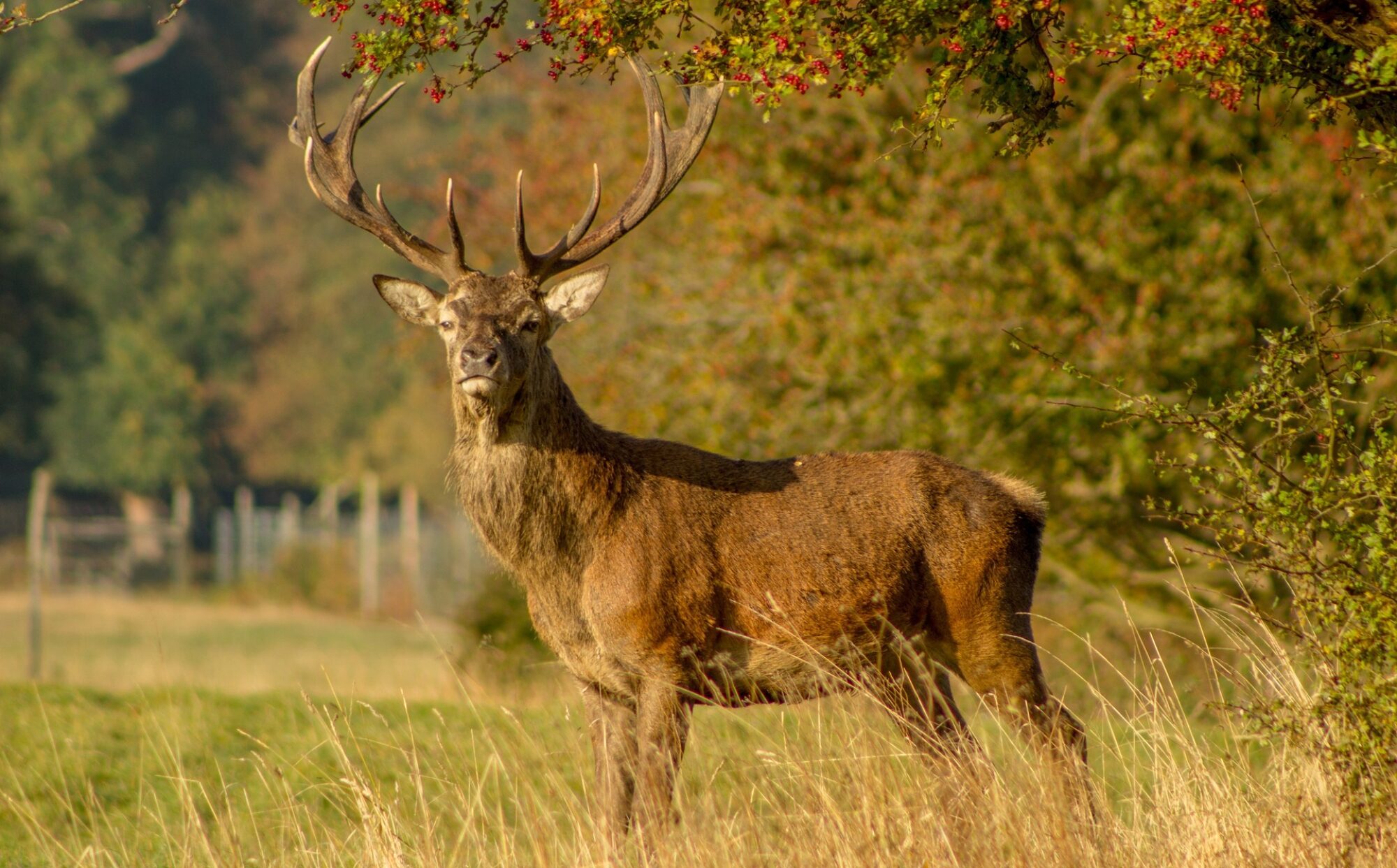
- There is plenty of white-tailed deer in Delaware, and they can be seen everywhere. The best time to see them is early in the morning or late in the evening when feeding. You might even see a buck with his impressive antlers if you are lucky. White-tailed deer are gentle creatures and make for great photographic subjects. If you are ever in Delaware, keep your eyes peeled for these beautiful animals.
- The sika deer is a medium-sized deer with a black or dark brown coat and grows 2.5 feet tall at the shoulder. They weigh 50-100 pounds and have a dark brown to black sika deer coat. Some may even have faint white parallel dots on their backs. They also have a white rump. Males are larger than females and have antlers. Males have a shaggy, black mane that runs down their neck and reaches to the ground.
- Gray squirrels are common animals in Delaware, small in size with little bushy tails. The Gray Squirrel fur coat is dark gray with rusty brown highlights, a white belly, and long pointy ears.
- Adult coyotes generally weigh 20–45 pounds. They have straight, pointed ears and a bushy tail. Coyotes are usually brownish gray with a light gray to cream-colored belly.
- The wild turkey is a giant, plump bird. It has a broad, rounded tail, elongated legs, and a long slim neck with a tiny head. Their color is dark, with blackish body feathers.
Public Lands
Approximately 68,000 acres of Delaware land are managed by the Division of Fish and Wildlife, which encompasses 19 public wildlife areas that offer hunting possibilities and habitats for a range of species. The wildlife areas are managed with both conservation and recreation in mind, providing places for people to enjoy the outdoors while also protecting natural resources. Many of the wildlife areas offer opportunities to hunt a variety of game species, including deer, turkey, waterfowl, and small game. Some also provide access to fishing, hiking, canoeing, and other activities.
There are several fundamental rules and regulations that apply to all of the Division of Fish and Wildlife’s properties. There are also restrictions that apply solely to certain wildlife areas.
- Assawoman Wildlife Area, founded in 1954, is a state wildlife area located in Sussex County. It consists of three massive tracts of land, measuring 1,300 hectares (3,100 acres), that were formerly farms. The name of the wildlife area was derived from the Little Assawoman Bay, formerly known as Assateague, meaning “inlet or stream in the middle.” Later, it was altered to another Algonkian name, meaning “fishing stream midway.”
To protect and support breeding populations of local animals like the eastern box turtle and migratory species like the wood thrush while also improving water quality in the Indian River, the Division of Fish and Wildlife planted 16,600 trees. In addition, by creating a living shoreline with salt marsh grasses, we created a 13,000-square-foot (1,200-meter2) barrier between a freshwater pond and a saltwater tributary. Finally, in 2020, it was announced that the Delmarva fox squirrel would be spread into the wildlife area from Dorchester County, Maryland, in an attempt to boost the population in Delaware.
- The Cedar Swamp Wildlife Area is in New Castle County, Delaware, on the coast of Delaware Bay. The area’s most significant feature is its transgressive brackish marshland. It is in the Northeastern coastal forests ecoregion. It is 5,515 acres (2,232 ha) in size and is run by the Delaware Department of Natural Resources and Environmental Control’s Division of Fish & Wildlife.
- The Nanticoke Wildlife Area is a state-protected nature area in Sussex County, along the Nanticoke River and Broad Creek, near Seaford and Bethel. It was founded in 1957 and is made up of three separate pieces of land totaling 4,510 acres (1,825 ha). A monument to John Smith’s expedition into the Chesapeake Bay and its tributaries can be found in Phillips Landing on Broad Creek, a Nanticoke River tributary in Delaware. The wildlife area also holds one of the few Delmarva fox squirrel populations, which is an endangered species within Delaware, along with controlled populations in the Assawoman Wildlife Area and Prime Hook Wildlife Refuge.
- Marshy Hope Wildlife Area is 1079 acres of state wildlife area made up of three land tracts in Sussex County, near the town of Bridgeville. It was founded in 2000. It is located along the Delaware and Maryland border and along the Delaware side of Marshyhope Creek.
- Delaware Sussex County’s Old Furnace Wildlife Area is a state wildlife area located about 1 mile (1.61 kilometers) to the east of Seaford, Delaware. It consists of four land tracts with a total of 2,237 acres (905 ha).
- Woodland Beach Wildlife Area is a state wildlife area located in Kent County, Delaware, along the shore of the Delaware Bay. It is 6,320 acres (2,558 ha) in size. Much of the area is a transgressive brackish marsh.
- Augustine Wildlife Area is located in New Castle County and is managed by the Department of Natural Resources and Environmental Control’s Division of Fish & Wildlife. The area consists of 3130 acres of upland and wetland habitats. The wetlands include freshwater marshes, brackish tidal marshes, and wooded swamps. The uplands are a mix of open fields, woodlots, and successional habitats. The area is a popular spot for hunting, fishing, bird watching, and nature photography.
- Little Creek Wildlife Area was founded in 1957 in Kent County. The area consists of 4721 acres of land and preserves a stretch of wetland along the Delaware Bay. The area is open to the public for hunting, fishing, and trapping. There is also a nature trail that winds through the area.
- The C&D Canal Conservation Area is located in New Castle. The area consists of 5090 acres of land and water managed by the State of Delaware to conserve and enhance the State’s natural resources. The C&D Canal, which links the Delaware Bay to the Chesapeake Bay, is an excellent example of a project that has benefited both nature and people. It protects land on both sides of the canal, passing through the Delmarva Peninsula.
The C&D Canal Conservation Area is open to the public for various activities, including hiking, fishing, hunting, and bird watching. A State Park permit is required for entry into the conservation area.
Regulatory Agency
The Department of Natural Resources and Environmental Control regulates the State’s natural resources and the environment by promoting a culture of conservation, improvement, and enjoyment of the environment.
They protect these resources for future generations, and where people understand that a healthy environment and a strong economy go hand in hand.
DNREC accomplishes this mission through its seven divisions:
- The Division of Air Quality keeps track of and controls all emissions into the air. It maintains statistics on industrial and commercial polluters.
- The Division of Water manages and protects Delaware’s water resources. It also aids in the financing of water pollution control techniques.
- The Division of Waste and Hazardous Substances are responsible for protecting human health, safety, and the environment through waste management. It is responsible for preventing pollution and handling time-sensitive emergencies and hazardous materials incidents 24*7.
- The Division of Climate, Coastal, and Energy is in charge of state-wide climate change balance and adaptation efforts. It gives funding for energy efficiency and clean fuel technology through grants.
- The Division of Fish and Wildlife manages and conserves Delaware’s fish and wildlife and their habitats on approximately 68,000 acres of public property. Public compliance with laws and regulations and fish and wildlife resource conservation, and safe boating are all enhanced through educational campaigns. The Division establishes hunting, trapping, and fishing regulations.
- The Division of Watershed Stewardship is in charge of and protects the State’s soil, water, and coastlines. It uses a variety of watershed-based initiatives to guarantee the sustainable use of natural resources.
- The Division of Parks and Recreation supervises more than 20,000 acres in state parks, nature preserves, and other sites outside of the parks. It also offers a wide range of recreational activities for residents and visitors.
Benefits of Coming to Hunt in Delaware
Delaware offers some great benefits that make it a top destination for hunters from all over when it comes to hunting.
It is sure to be a hunting destination that you will love with its many benefits. Here are just a few of the reasons why you should consider coming to hunt in Delaware:
- The State has a diverse landscape that includes forests, fields, and wetlands – all of which are home to a variety of game species. This means that you can find the type of environment you prefer and the type of game you are seeking.
- Delaware has a long hunting tradition and culture. This means that plenty of resources are available for you, including gear, guides, and lodges.
- You will see some fantastic wildlife. Delaware is home to a variety of wildlife, including deer, turkey, and quail. Hunting is a great way to see these animals up close and personal. This means that you can find the type of hunt you are looking for, whether you are seeking a challenging trophy hunt or a more relaxed family outing. The State has a large population of White-tailed deer, making it a great place to come for a successful hunt.
- With easy access to public hunting land and a variety of private hunting clubs, you will be able to find the perfect place to hunt in Delaware.
- Delaware is consistently ranked as one of the safest states in the country, so you can rest assured that you and your family will be safe while you are here. You can choose to hunt in a group or go solo.
- Thanks to the plentiful game and the State’s liberal hunting laws, hunters who come to Delaware often find success. The State has enacted regulations that help to ensure a fair chase hunting experience. This means that the deer have a better chance of escaping, making your hunt more challenging and rewarding.
- From the Delaware beaches to the rolling hills of the interior, Delaware offers some magnificent scenery for you to enjoy while you are here. Hunting in Delaware is a great way to connect with nature and experience all that the State offers.
- Delaware offers various hunting seasons, so you can choose the time of year that works best for you.
- The State has several different lodging options available, so you can find a place to stay that fits your budget and needs.
- The people of Delaware are friendly and welcoming, making your hunt even more enjoyable.
- Hunting is a great way to create lasting memories. Whether you are spending time with family or friends, you are sure to make some great memories while hunting in Delaware.
Hunter’s Bottom Line
Hunting is a great way to enjoy the outdoors and spend time with friends or family. There is nothing quite like the feeling of being out in nature, and when you are hunting, you are really in tune with your surroundings. Plus, it is a great way to get some exercise! Hunting can be a great way to learn new skills. Whether you are learning how to track an animal or properly use a firearm, you will be able to take away valuable knowledge from your hunting experiences. One of the most rewarding aspects of hunting is the chance to harvest an animal. This can provide you with food for your family or even trophies to display.
Delaware may be small, but it packs a big punch when it comes to hunting opportunities. The “First State” is home to a diverse range of wildlife, including white-tailed deer, wild turkeys, small game, and waterfowl. In addition, Delaware’s forests offer a variety of habitats that are ideal for hunting, from open fields to dense woodlands. And with over 100 public hunting areas totaling more than 23,000 acres, there’s plenty of room for everyone. So, whether you are a seasoned hunter or just getting started, Delaware is the perfect place to pursue your passion. With its convenient location on the East Coast, Delaware is easy to get to and offers a wide range of accommodations and amenities to make your hunt comfortable and enjoyable. In addition, the State offers a variety of licenses and permits that make it easy for hunters to get started.
Delaware is relatively accessible, located in the Mid-Atlantic region of the United States. This makes it easy for hunters to get to the State and enjoy all it offers.
The weather is relatively mild compared to other states in the region. This means that you can hunt almost year-round if you want to. From the forests of the northern part of the State to the marshes of the southern coast, there is something for every hunter in Delaware. Delaware has a strong commitment to wildlife conservation. The State has put several programs to ensure that game populations remain healthy and sustainable. In addition, Delaware is home to some of the best hunting outfitters and guides in the country. If you need help planning your hunt, these professionals can ensure that you have a successful and enjoyable experience.
So, if you are looking for a great place to hunt, Delaware should be at the top of your list. The State has everything you need for a successful hunt, and the people who live here are passionate about hunting and conservation. In addition, Delaware is sure to please any hunter with its diverse landscape, rich hunting tradition, and ample hunting opportunities.
So, what are you waiting for? Start planning your Delaware hunting adventure today!