Colorado Hunters Dream State
Colorado is a landlocked state in the Western US, with terrain that varies from the flat eastern plains to the rugged Rocky Mountains. The physical features of Colorado are primarily the result of its position along the Continental Divide. This great ridge of mountains and valleys separates the waters flowing east into the Gulf of Mexico from those flowing west into the Pacific Ocean.
The Rocky Mountains dominate Colorado’s landscape. They include some of the highest peaks in North America, including 14,440-foot (4,401 meters) Mount Elbert, Colorado’s tallest mountain. The Rockies are a young mountain range formed only about 80 million years ago. They are still growing today, as evidenced by the many earthquakes that occur in Colorado each year.
Between the Rocky Mountains and the eastern plains is a high plateau region known as the Colorado Plateau. This area is home to some of the state’s most iconic landmarks, including the Great Sand Dunes National Park and Mesa Verde National Park.
The Eastern Plains are a relatively flat, featureless region that makes up the eastern third of Colorado. The area is home to the state’s largest city, Denver, and its largest metropolitan area, the Denver-Aurora-Lakewood Metropolitan Statistical Area.
Colorado’s climate is highly varied due to its position along the Continental Divide. The state’s western side, including the Rocky Mountains, has a colder, drier climate, while the eastern plains are warmer and more humid. The state’s high altitude also contributes to its varied weather patterns.
In addition to its varied landscape, Colorado is also home to a wide variety of plant and animal life. The Rockies are full of pine and aspen trees, and the eastern plains are teeming with deer, antelope, and prairie dogs. There are also plenty of public lands to hunt wildlife in the mountains, including elk, bighorn sheep, and black bears.
Big Game Hunting in Colorado
- Elks
The San Juan Mountains, the White River National Forest, and the Routt National Forest are some of the most popular areas where Elk hunting is available. Elk hunting in Colorado is typically done during the fall season, as this is when the elks are in their breeding season. The best time to hunt for elk is early in the morning, as they are most active during this time. There are two main types of elk hunting in Colorado: bull elk hunting and cow elk hunting. Bull elk hunting is the most popular type of elk hunting in Colorado, as it offers hunters the chance to harvest a large animal. Cow elk hunting is also popular, but it is not as common as bull elk hunting.
- Mule Deer
The most popular areas for mule deer hunting are the Pike National Forest, the Arapaho National Forest, and the White River National Forest. Mule deer hunting season in Colorado typically starts in late September and lasts through early December. They are found statewide, mainly in mountain shrubs and foothills.
- Bighorn Sheep
The most popular areas for bighorn sheep hunting are the Gunnison National Forest, the Uncompahgre National Forest, and the White River National Forest.
- Moose
Moose hunting season in Colorado typically starts in mid-September and lasts through early November.
- Pronghorn
The most popular areas for pronghorn hunting are the Gunnison National Grassland, the Laramie Plains, and the Pawnee National Grassland.
- Black Bears
The most popular areas for black bear hunting are the San Juan Mountains, the White River National Forest, and the Routt National Forest. Black bear hunting season in Colorado typically runs from early August through early November.
- White-tailed Deer
White-tailed deer are common on Eastern Plains, in streamside woodland areas, and cropland along rivers.
Big Game Hunting Weapons
- CENTERFIRE RIFLES
- Centerfire Rifles must be at least 26 in length, having a minimum diameter of .24 caliber (6 mm). It must have a 16-inch barrel. A maximum of six rounds may be loaded in the magazine and chamber combined if the weapon is semiautomatic.
- It must use expanding bullets weighing at least 70 grains for deer, pronghorn, and bear, 85 grains for elk and moose, and kinetic energy of 1,000 ft.-lbs. as certified by the manufacturer.
- Smart Rifles, including any firearm with a target tracking system, electronically controlled triggered or aided, or computerized trigger is prohibited. A scope with a computer processor is considered a “smart rifle.” Fully automatic rifles are not permitted.
- MUZZLELOADING RIFLES & SMOOTHBORE MUSKETS
- An In-line muzzleloader is allowed. A single-bore firearm that fires a single round ball or conical projectile is acceptable in muzzleloading seasons.
- Conical bullets for deer, pronghorn, or bear hunting must be a minimum of .40 caliber. Round-ball projectiles must be a minimum of.50 caliber to hunt elk or moose. Conical bullets must be at least.50 caliber to kill an elk or moose, while round-ball bullets must be at least .54 caliber.
- The weight of a bullet is measured in grains, and the minimum required for a barrel diameter of .40 to .50 calibers is 170 grains. Bullets exceeding caliber .50 must weigh at least 210 grains.
- Fiber-optic sights and fluorescent paint are permissible, either directly inside or onto the open or iron sights. Batteries and electronic equipment are prohibited during muzzleloading seasons.
- Muzzleloading seasons are prohibited for the use of smokeless powder. Black-powder and black-powder substitutes are allowed.
- SHOTGUNS
- To be legal, shotguns must fire a single slug and have a gauge of at least 20. b. The barrel must be at least 18 inches long. The overall length must be at least 26 inches. Buckshot is not permitted for hunting big game.
- 4. HAND-HELD BOWS
- The string is not drawn or held mechanically under tension on a longbow, recurve bow or compound bow. String or mechanical releases are acceptable if they are hand-drawn or hand-held and do not have any additional attachments or connections to the bow (except for the bowstring).
- Handheld bows must use broad-headed arrows with a minimum 7/8-inch outside width and two steel cutting edges. The entire length of the cutting surface requires that each cutting edge is in the same plane. 35 pounds is the minimum draw weight required.
- Bows may only shoot one arrow at a time. There can be no mechanisms used for loading arrows automatically. Arrows cannot be propelled using hydraulic or pneumatic power. Explosive arrows are prohibited.
- CROSSBOWS
- The draw weight must be at least 125 pounds. The draw length must be at least 14 inches from the front of the bow to the nocking point of the drawstring.
- The primary cutting edge of the blade must be at least 16 inches long, with a broadhead that is at least 7/8-inch wide and has at least two steel cutting edges. For the complete length of the cutting surface, each sharpening side must be in the same plane.
- Crossbows are illegal during archery seasons.
- HANDGUNS
- The barrel of a handgun must be at least 4 inches long. Expanding bullets with a diameter of at least 0.24 cm are required.
- Shoulder stocks are not permitted. A cartridge or load that generates 550-ft.- pounds of energy at 50 yards as certified by the manufacturer is required.
Small Game Hunting
Small Game in Colorado are:
- Game mammals, including
- Cottontail rabbit Snowshoe hare and jackrabbit having daily bag limit of 10 of each species and possession limit of 20 of each species
- Fox squirrel and Pine squirrel with daily bag limit 5 of each species and possession limit 10 of each specie
- Marmot has a daily bag limit of 2 and a possession limit of 4
- Abert’s squirrel has a daily bag limit of 2 and a possession limit of 4
Other small game, including
- Black-tailed, white-tailed, and Gunnison prairie dogs with unlimited bag limit and possession limit
- Wyoming (Richardson’s) ground squirrel with unlimited bag and possession limit.
Game birds include
- Dusky grouse, Greater Sage-grouse, Gunnison Sage-grouse, mountain sharp-tailed grouse
- White-tailed ptarmigan
- Pheasant,
- Northern bobwhite, scaled and Gambel’s quail
- Chukar partridge
- Greater prairie-chicken
- Wild turkey
“Furbearers” refers to animals with commercial worth and potential for sport hunting, including
- Mink,
- Pine marten,
- Badger,
- Red fox, gray fox, swift fox,
- Western spotted skunk beaver,
- Muskrat,
- Long-tailed weasel and short-tailed weasel
- Bobcat
- Opossum
- raccoon.
A furbearer license (with a small-game or combo license) or furbearer harvest permit is required to hunt or capture these species.
To hunt and take small game, you must have a small-game license, a combination small-game/fishing license, or a lifetime combo small-game/fishing license. In addition, before the first hunting trip, small-game hunters must register with the HIP.
Small Game Hunting Weapons
The legal methods of hunting small game animals in Colorado are:
Rifles
- Any weapon with a computerized scope is considered a smart rifle. SMART RIFLES, having target tracking technology, electronic control, assisted or computer-linked triggers, or ballistics computers, are all prohibited. A gun equipped with a scope containing a processor is
- Fully automatic rifles are not allowed.
Handguns include pistols and revolvers, without shoulder stock or attachment.
Shotguns
- Shotguns that are no larger than 10 gauge.
- Shotguns should not hold more than 3 shells in magazines and chamber combined.
- It should have at least an 18-inch barrel and is at least 26 inches in overall length.
Hand-held bows and crossbows.
Air guns
- Any rifle or handgun having .177 caliber or larger firing pellets, slugs, or round ball ammunition powered by high-pressure air is allowed, including pellet guns and pneumatic weapons.
Slingshots
- It is a hand-held device manually drawn or tied with an elastic band attached to arms or attachment points for propelling stones or metal projectiles. Wrist-brace attachments and non-elastic projectile pouches are standard parts of a slingshot.
Hawking or Falconry
FOR SMALL-GAME BIRDS
- Rifles or handguns allowed for dusky grouse and ptarmigan.
- Shotguns cannot be larger than 10 gauge and must not hold more than 3 shells in magazine and chamber combined.
- Hand-held bows are longbow or compound bows with a manually held or drawn string are allowed.
- Crossbow is allowed. The bow must be fired from the shoulder, attached perpendicularly to its stock with a mechanical device to hold string cocked.
- Slingshots and Air guns are allowed for dusky grouse and ptarmigan.
- Hawking or Falconry
Colorado’s Native Species
Colorado is home to a diverse and interesting set of native species. Colorado is teeming with life from the majestic Rocky Mountains in the west to the wide-open prairies in the east.
Colorado is an excellent state for big game hunting, with various options available to hunters.
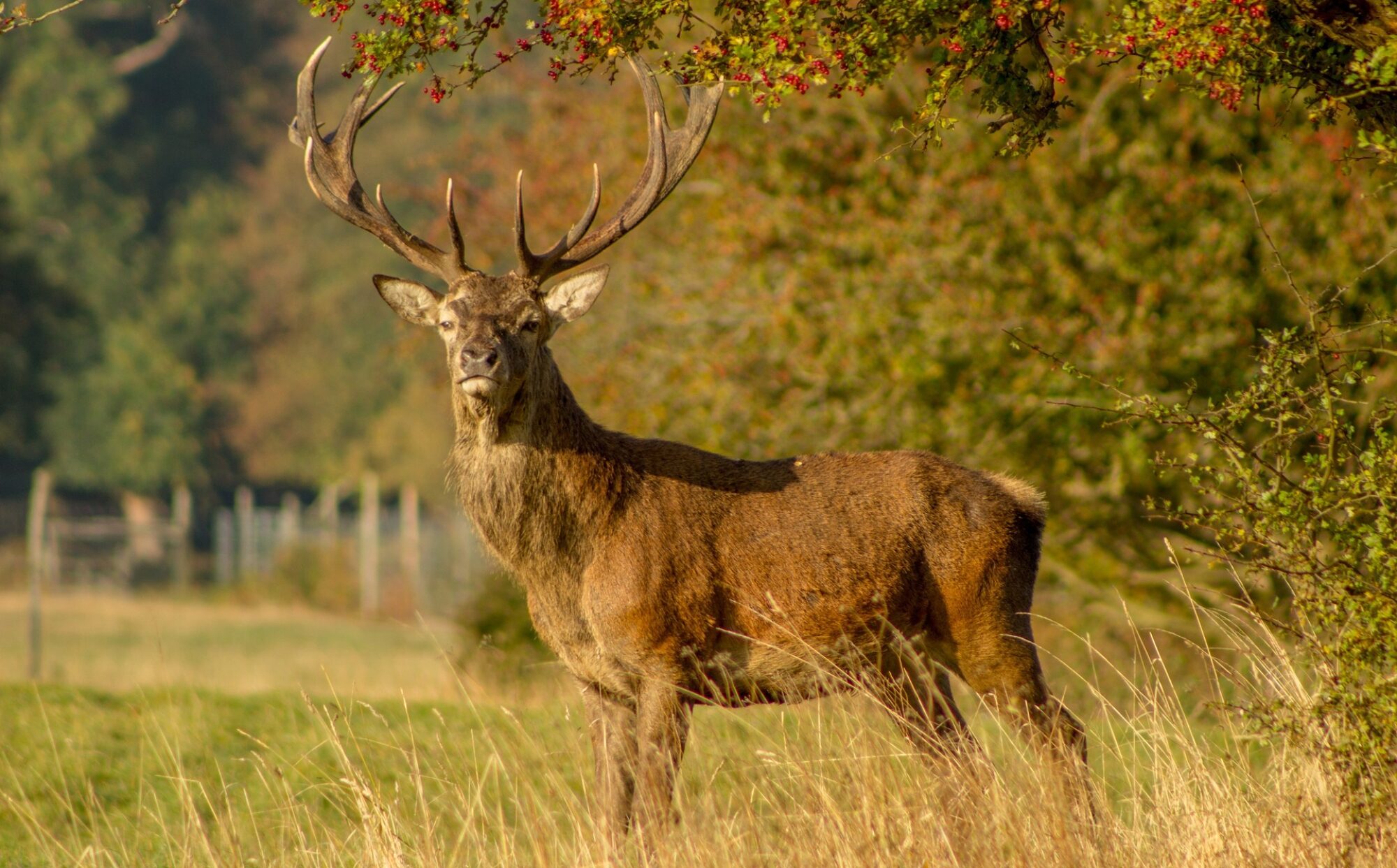
- Elks have red, dark brown legs, a chestnut brown neck with antlers that are not palmated, and brow tines coming off the main beam.
- Mule deer have black-tipped tails and white rump patches. Their ears are large, and they have antlers that fork as they grow. Bucks will continue to grow their antlers until they are four years old.
- Bighorn sheep have brown fur and white rumps. Their horns curve backward, and they have well-defined rump patches. Rams will continue to grow their horns until they are seven years old.
Male Bighorn can weigh up to 350 pounds and females up to 200 pounds.
There are two types of Bighorn sheep – Desert bighorn sheep and Rocky Mountain.
- Moose are the largest member of the deer family. They have brown fur and a long, bulbous nose. Males have enormous antlers that can spread up to six feet wide.
- White-tailed deer have broad and brown whitetails, and ears are smaller in proportion to the head. Antlers consist of one main beam with three to five tines pointing upward.
- Pronghorn has brown and white fur and black horns. Males have more giant horns than females. Pronghorn can weigh up to 150 pounds.
- Black Bear adults have long, thick hair, whereas yearlings may have thin, bleached-looking hair. A huge bear can be identified with small ears and a big head. Young bears with narrow faces and lengthy noses are not yet adults.
- Cottontail rabbit, Snowshoe Hare, and Jackrabbit.
- Black-tailed, white-tailed, and Gunnison prairie dogs
- Fox squirrel, and Pine squirrel
- Mourning doves are 12 inches long from the tip of the beak to the end of the tail and grayish-brown color. They have a long, pointed tail with rapid wing beat and erratic flight.
- White-winged doves are slightly bigger than mourning doves and Gray-brown color. They have long, moderately rounded tails. They have a white bar on the upper wing surface.
- Eurasian collared doves are 15 inches from the tip of the beak to the end of the tail and dark grayish-brown. They have a long, squared tail thin black band on the neck with a white upper border. Gray belly and under tail coverts with black on the tail. They are larger and heavier than the Mourning dove.
- Dusky grouse, Greater Sage-grouse, Gunnison Sage-grouse, and mountain sharp-tailed grouse
- Wild Turkey
Public Lands to Hunt in Colorado
SWAs are areas of the state- or privately-owned land managed by and managed under state law by Colorado Parks and Wildlife that provide public access to wildlife-related leisure. While most activities focus on hunting and fishing, each SWA has different permitted activities dependent on location and existing resources. Sportsmen and sportswomen contribute to the cost of these SWA properties. CPW manages more than 300 SWA lands throughout Colorado.
Any visitor must have a valid hunting or fishing license or the new Colorado State Wildlife Area Pass to be on any part of the State Wildlife Area (SWA).
Colorado is home to many different types of wildlife, including deer, elk, bears, and mountain lions. There are also plenty of bird species, including grouse, chukar, and quail. If you are looking to get up close and personal with Colorado’s wildlife, there are plenty of State Wildlife Areas to do so.
- The North Lake State Wildlife Area is a readily accessible designated wilderness area located along the Highway of Legends (State Highway 12) in Las Animas County, Colorado.
The North Lake SWA provides some of the best access to high-elevation habitats in southern Colorado. You can spot owls within the dense Rocky Mountain wilderness. It is frequented by a large variety of wildlife, including black bears, deer, elk, porcupines, minks, and more.
You can enjoy boating and camping with a small fee and prior booking. Public amenities include horse stables, picnic tables, grills, fire rings, pit toilets, and water access. Licensed anglers can enjoy fishing cutthroat trout and kokanee salmon in the cold-water lake and streams. The SWA also offers hiking pathways that may be followed to discover more of the wilderness by foot, mountain bike, or horseback.
Hunting can be done in the designated safety zone of the North Lake SWA, where you can find big and small game, including deer, bear, elk, and turkey.
- The Mount Evans State Wildlife Area is a 3,438-acre destination for enjoying picnicking, nature’s beauty, camping, fishing, hiking, and hunting.
You will require a valid state fishing, hunting, or public lands license for every visitor 18 years and above. There are no additional fees for using the area’s bathroom, parking, and camping facilities.
Mount Evans SWA is an important breeding place for rocky mountain elks. In addition, the area’s dense forest is full of various bird and animal species that grab visitors’ attention at every mile.
The area around Mount Evans State Wildlife Area is rich in hiking opportunities that extend into the neighboring Arapaho National Forest. Hikers of all skill levels can appreciate the beauty along with the Beaver Meadows, Lost Creek, Beartrack Lakes, or Captain Mountain paths.
The area is famous for hunting big games and small games, especially elk, grouse, rabbit, etc.
- The Beaver Creek State Wildlife Area is a scenic destination amassing 2227 acres of land for hunting, fishing, and hiking in Fremont County.
Elevation ranging from 5,720 feet to 9,206 feet, the Beaver Creek SWA can be accessed on foot via a 12-mile hiking trail along West Beaver Creek.
Beaver Creek SWA is a remote and quiet wilderness destination with excellent wildlife viewing and birding opportunities. There is a high chance to spot elk, bighorn sheep, deer, bears, mountain lions, coyotes, foxes, rattlesnakes, and more.
Nature and Wildlife enthusiasts flock to the Beaver Creek SWA looking to find owls, eagles, and falcons and rarely seen species like dippers, kingfishers, and other waterfowl.
- Shriver-Wright SWA is a beautiful wilderness area of 120 acres offering hunting opportunities for deer, rabbit, dove, waterfowl, and more. Other recreational activities include cold-water river fishing, wildlife viewing, and photography. Hunters should be aware that only shotgun, bow, muzzleloader, or falconry is allowed for hunting animals. Also, follow hunting regulations regarding specific closures of waterfowl hunting.
- Sikes Ranch SWA is a vast stretch of 7,139 acres of land open for public access 1 hour before sunrise to 1 hour after sunset. Hunters may remain as long as reasonable to retrieve downed game. Wildlife observed for hunting are deer, turkey, and other big game and small games. Night hunting and trapping are allowed with permits only. Lakes and streams in the SWA provide various aquatic species like green sunfish black bullhead catfish for fishing.
- Two Buttes Res. SWA in Prowess and Baca County is 8,533 acres of the wilderness area, offering visitors to spend their day immersed in various enjoyments. You will find ample opportunities to hunt deer, pronghorn, pheasant, rabbit, bobwhite quail, scaled quail, dove, and waterfowl for hunting enthusiasts. Fishing is allowed where you can find seasonal trout, bluegill, channel catfish, and largemouth bass. For adventurers, you can go camping, hiking, and rock climbing. Two buttes Res. SWA provides facilities for the public to avail like rifle range, restrooms, and drinking water.
- Wellington SWA is spread across 1,793 acres. Hunting is allowed with an abundant variety of small game and game birds like rabbits, pheasant, dove, and waterfowl. Big-game hunting only with archery, shotguns with slugs, and muzzleloading. You can enjoy many other recreational activities such as hiking, wildlife viewing, and warm water fishing. Target practice is allowed if authorized by Area Wildlife Manager.
- Jumping Cow SWA in Elbert County is a vast 14,733 acres of property. Hunting is done by special drawing permit only for doe white-tailed, doe mule deer, doe pronghorn, dove, and waterfowl. Hunting access is given to those who have a valid license before applying for a permit, with priority given to mobility-impaired hunters and mentored youth hunters. Permits are not valid for the entire property but only for designated hunt zones. Hunters with permits can take one other non-hunter along with them, and for mobility-impaired hunters, two non-hunters can accompany.
- Karney Ranch SWA is a vast 13,580 acres of public land. You can enjoy hunting deer, pronghorn, and small games or immerse in the natural beauty of this SWA. Access is allowed by foot only as vehicles are restricted in the property. You can take dogs as an aid in hunting. Additional permits will be required for night hunting with artificial light for certain species.
Colorado Regulatory Agency
Colorado Parks and Wildlife (CPW) is a state agency that falls under the Colorado Department of Natural Resources. Colorado Parks and Wildlife is renowned for its conservation, outdoor leisure, and wildlife management experts.
CPW manages over 900,000 acres of public land and operates 42 state parks and more than 350 wildlife areas. The agency also offers a variety of outdoor recreation opportunities, including camping, fishing, hiking, and hunting. The agency is funded primarily by hunting and fishing license fees and federal matching funds. It is governed by an eleven-member commission appointed by the governor.
The mission of Colorado Parks and Wildlife is to perpetuate the state’s wildlife resources and provide a quality state parks system. Also, provide sustainable outdoor recreational opportunities that inspire current and future generations to protect Colorado’s natural resources.
CPW issues fishing and hunting licenses conduct research to assist wildlife management, secures high-value habitat through purchases and partnerships, provides technical assistance to private and government landholders on wildlife and habitat management. It also creates programs to study, preserve, and recover threatened or endangered species.
Colorado Parks and Wildlife enforce hunting and fishing regulations and restore damaged habitats.
CPW manages the state’s parks, trails, wildlife refuges, and other outdoor recreational opportunities. The agency also manages the state’s trail program and registers boats, snowmobiles, off-highway vehicles, and river outfitters.
The values of Colorado Parks and Wildlife are:
- We exist to protect and enhance wildlife and its habitat for the use, enjoyment, and benefit of all.
- People are key to our success. We partner with others to achieve our mission.
- We are good stewards of Colorado’s natural resources. We use sound science in decision-making.
- We are fiscally responsible and accountable. We use our resources wisely.
Benefits of Coming to Hunt in Colorado
If you are an avid hunter, you know that Colorado is one of the best places to hunt in the United States. Colorado provides ample opportunity to bag big game with its expansive forests and mountains. But what are some of the other benefits of hunting in Colorado?
There are many reasons to come hunt in Colorado, but here are 8 key benefits:
- Colorado offers some of the most beautiful scenery in the country. From the towering Rocky Mountains to the rolling plains, there is something for everyone to enjoy. The scenery and natural beauty of the state are unsurpassed. In addition, Colorado offers hunters a breath-taking backdrop for their sport, from the sweeping Rocky Mountain vistas to the verdant river valleys.
- Colorado has a long tradition of hunting and wildlife management. As such, the state boasts some of the best game populations in the country. The variety of game species available to hunt is unmatched. Elk, mule deer, white-tailed deer, bighorn sheep, pronghorn antelope, moose, bear, mountain lions, and wild turkey are just a few of the animals that call Colorado home.
- Colorado offers a variety of hunting experiences, from DIY hunts to fully-guided packages. In addition, the state is home to some of the best outfitters and guides in the business. With vast experience in hunting Colorado’s diverse terrain and game, these professionals can help you bag your trophy.
- The Colorado hunting season is one of the longest in the country. This gives hunters ample opportunity to chase their quarry during the best times of the year.
- Colorado offers some of the most liberal hunting regulations in the nation. This allows hunters to tailor their hunt to their specific desires and needs.
- The state has a rich hunting tradition and culture. With a long history of hunting in Colorado, you can be sure to find fellow hunters who share your passion for the sport.
- With so much public land available for hunting, you are sure to find the perfect spot to set up camp. Many lodges and campgrounds are available, so you can find the ideal place to stay during your hunt.
- Colorado is home to several experienced and professional outfitters who can help you plan the perfect hunting trip. From booking your lodging to arranging for transportation and guides, these outfitters can take care of all the details so you can focus on enjoying your hunt.
Colorado is simply a great place to be. Colorado is the perfect destination for your next hunting adventure with its stunning scenery, diverse wildlife, and friendly people. So, if you are looking for a great place to hunt, be sure to consider Colorado. With its abundant game populations and beautiful scenery, it is the perfect destination for any hunter.
Hunters Bottom Line
Colorado is a land of diverse terrain and topography. The Rocky Mountains run north to south through the state, and the eastern plains are primarily flat prairie land. This variety in the landscape creates a wealth of recreational opportunities for Colorado residents and visitors alike.
Colorado is a big state with plenty of diverse terrain and topography, making it an excellent destination for hunters. Colorado’s forests and mountains offer plenty of opportunities for hunting big game. Colorado’s prairies and forests provide ample opportunities for hunting smaller game. The state is home to many rivers and lakes, which provide ample opportunities for waterfowl hunting.
The mountains are famous for skiing, snowboarding, hiking, and camping in the summertime, and the plains are great for fishing, horseback riding, and golfing.
If you are looking for a great hunting opportunity in Colorful Colorado, look no further than the terrain around Grand Junction. With its vast open spaces and varied terrain, this area offers something for everyone – whether you are looking to hunt big game like elk or deer or small game like rabbits or squirrels. There are also plenty of birds to be pursued in the area, including grouse, pheasant, and turkey. And do not forget about the Colorado River corridor, which offers some great fishing opportunities. So, if you are looking for a hunting or fishing adventure in Colorado, be sure to check out Grand Junction!
The state’s diverse terrain and topography and its abundance of wildlife make it a top destination for hunters. Thanks to Colorado’s rich hunting traditions, hunters will also find plenty of excellent hunting opportunities in the state. Hunters will find plenty of public lands to hunt on and private land with access to some of the best hunting in the state. Seasons and bag limits vary by species and area, so ensure checking the regulations before heading out.
Whether you are a seasoned hunter or just getting started, Colorado is a great place to
pursue your passion. With its diverse terrain and plentiful game, there is something for everyone. So, get out there and enjoy the hunt!
So come to Colorado and experience all that our amazing state has to offer! We guarantee you will not be disappointed.